Freecell 247 Solitaire is a great choice for players who enjoy classic card games, thoughtful decisions, and puzzles that reward careful planning. Unlike games that depend heavily on luck, FreeCell challenges you to study the cards, identify useful moves, and organize each column strategically. Because all cards are visible from the beginning in standard FreeCell, you can plan your approach instead of waiting for hidden cards to appear.
Whether you are a beginner learning the rules or an experienced player looking for a fresh challenge, understanding the game’s mechanics can make every session more enjoyable. You can explore different strategies, learn how to use free cells effectively, and discover related games such as Spider Solitaire and Baker’s Game. This guide covers the essential rules, practical tips, common mistakes, and popular variations to help you enjoy online FreeCell with greater confidence.
What Is Freecell 247 Solitaire?
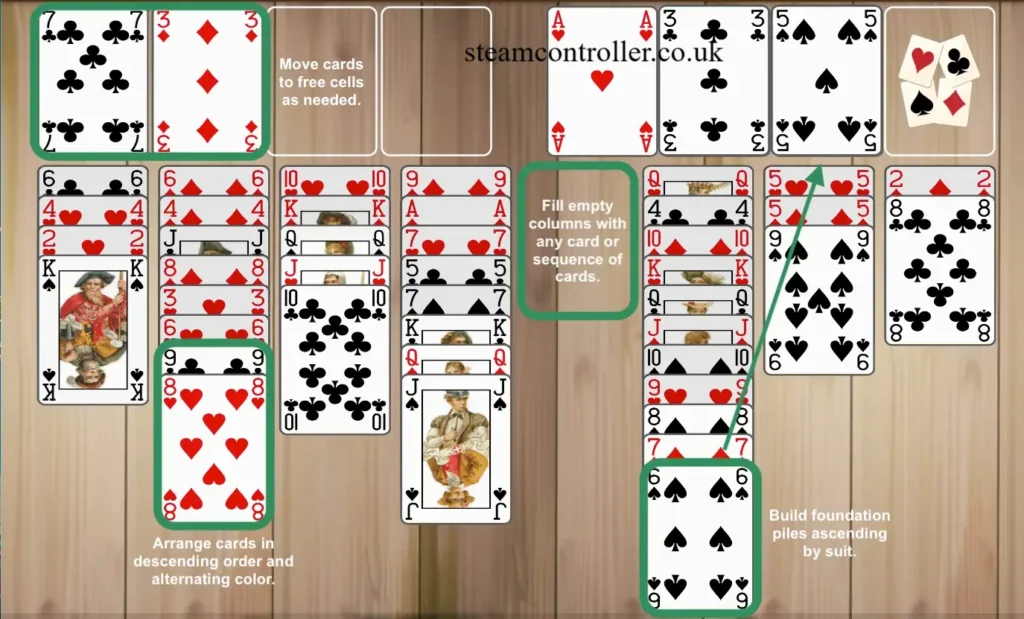
Freecell 247 Solitaire is a browser-based card-game search term associated with the familiar FreeCell Solitaire experience. The traditional game uses a standard 52-card deck arranged into eight tableau columns. Four free cells provide temporary storage for individual cards, while four foundation piles serve as the final destination for cards arranged by suit from ace through king.
The main appeal of FreeCell is its emphasis on strategy. Since every card is visible at the start of a standard game, you can evaluate the layout and plan several moves ahead. Successful play depends on recognizing sequences, opening blocked cards, and managing empty spaces carefully. Many players enjoy this combination of logical thinking, accessible rules, and the satisfaction of completing a challenging
sourecs: 247freecell.com
How to Play Freecell 247 Solitaire Online
To begin playing, open a website that offers FreeCell Solitaire and start a new game. The exact controls depend on the platform, but most browser versions let you move cards by clicking or dragging them. Before making your first move, examine all eight tableau columns and identify aces, useful sequences, and cards that may be difficult to access.
The objective is to move all 52 cards to four foundation piles, with each pile containing one suit in ascending order from ace to king. You can move cards between tableau columns, place individual cards in available free cells, and transfer eligible cards to the foundations. Building descending sequences with alternating red and black cards is central to standard FreeCell strategy.
A simple approach for beginners is to:
- Look for aces and low-value cards that can begin foundation piles.
- Identify moves that uncover important cards or create empty columns.
- Use free cells to temporarily hold cards that block useful sequences.
- Keep track of available spaces before moving several cards.
- Recheck the board after each significant move.
Essential Rules and Gameplay Features
Understanding the rules helps you avoid unnecessary moves and recognize opportunities. In standard FreeCell, tableau sequences are built in descending order with alternating colors. For example, a black nine can be placed on a red ten. You can move eligible cards between columns, provided the resulting arrangement follows the game’s rules and the available spaces support the move.
The four free cells can each hold one card, making them valuable temporary storage spaces. Empty tableau columns are also important because they provide room to rearrange sequences and expose cards that were previously difficult to move. Foundation piles are built upward by suit, starting with an ace. Although moving cards to the foundations is often useful, leaving certain cards in the tableau temporarily can preserve important moves.
| Game element | Purpose |
|---|---|
| Tableau columns | Hold and organize cards into descending sequences |
| Free cells | Temporarily store individual cards |
| Foundation piles | Collect each suit from ace through king |
| Empty columns | Provide space for rearranging cards |
| Undo option | May let you reverse a move, depending on the platform |
Best Freecell 247 Solitaire Strategies for Winning More Games
Good strategy begins with thinking beyond the next available move. Before transferring a card, consider what the move will reveal, which spaces it will occupy, and whether it could block another sequence. Prioritize moves that uncover useful cards and create flexibility. An apparently small change can open an entire column and make several previously unavailable moves possible.
Managing empty spaces is equally important. Avoid filling every free cell early because doing so reduces your options for handling blocked cards. When you create an empty tableau column, use it deliberately rather than filling it immediately. Depending on the layout and the platform’s movement rules, an empty column can help you reorganize a sequence and access cards that are essential for completing the game.
Remember these practical principles:
- Keep at least one free cell available whenever possible.
- Prioritize moves that reveal useful cards.
- Create empty tableau columns when they support a clear plan.
- Avoid unnecessary transfers that leave important cards blocked.
- Think about the next few moves before committing to a sequence.
- Delay foundation moves when a card may still be needed to rearrange the tableau.
Freecell 247 Solitaire Online: Tips for Beginners
If you are new to FreeCell, focus on understanding the board before trying complicated strategies. Begin by locating aces and twos, checking which cards can move immediately, and identifying columns that contain useful cards near the bottom. You do not need to solve the entire game in your head. Instead, develop a habit of checking how each move changes the available options.
Another useful habit is to avoid moving cards simply because a legal move is available. A move can be valid but still make the game harder by occupying a free cell or blocking a valuable card. If your website provides an undo feature, you can use it to examine the consequences of different decisions. Over time, reviewing your moves will help you recognize patterns and make more deliberate choices.
Popular FreeCell 247 Variations and Related Games

FreeCell belongs to a broader family of solitaire and logic games. Exploring related titles can introduce different rules and challenges while keeping the familiar appeal of arranging cards or solving puzzles. Some games use similar card movements, while others require completely different approaches.
Spider Freecell 247
Spider Solitaire differs from traditional FreeCell because its gameplay focuses on building sequences and removing completed runs. Depending on the version, players work with one, two, or four suits, and the difficulty changes accordingly. Searching for spider freecell 247 may help players discover related solitaire games, but Spider Solitaire should not be confused with the standard FreeCell rules.
Baker’s FreeCell 247
Baker’s Game is a close relative of FreeCell with an important difference: tableau sequences are built in descending order by suit rather than by alternating colors. This restriction changes which cards can be placed together and often requires more careful planning. Players searching for baker’s freecell 247, baker’s game freecell 247, or freecell 247 bakers are generally looking for this alternative style of gameplay.
FreeCell 247 Eight Off
Eight Off is another related solitaire variation. It traditionally offers eight reserve cells, giving players more temporary storage than standard FreeCell. However, the layout and movement rules differ, so the additional cells do not automatically make every game easier. Players must still organize cards thoughtfully and preserve room for future moves.
FreeCell 247 Mahjong
Mahjong Solitaire is a tile-matching puzzle rather than a card game. Players remove matching pairs of eligible tiles while ensuring that the selected tiles are not blocked according to the game’s rules. The appeal is similar in that both games reward careful observation and planning, but the objectives and mechanics are different.
FreeCell 247 Sudoku
Sudoku is a number-placement puzzle in which players complete a grid while following row, column, and box constraints. It does not use cards or free cells, but it appeals to people who enjoy logical challenges. If you like analyzing possibilities and eliminating incorrect options in FreeCell, Sudoku may offer another engaging way to spend your puzzle-solving time.
How FreeCell Compares With Other Solitaire Games
Different solitaire games suit different preferences. FreeCell emphasizes planning because all cards are visible in a standard deal. Klondike Solitaire introduces uncertainty through face-down cards and a stock pile, while Spider Solitaire focuses on building and removing longer sequences. Choosing between them depends on whether you prefer open information, uncovering hidden cards, or managing complex runs.
| Game | Main objective | Key challenge |
|---|---|---|
| FreeCell | Build four suit-based foundations | Manage free cells and plan moves |
| Klondike Solitaire | Complete foundations using the stock and tableau | Reveal hidden cards |
| Spider Solitaire | Build complete descending suit sequences | Manage long runs and blocked cards |
| Baker’s Game | Complete foundations with suit-based tableau sequences | Work within stricter movement rules |
| Eight Off | Complete foundations using additional reserve cells | Balance reserve space and tableau moves |
Benefits of Playing FreeCell Solitaire
FreeCell provides an enjoyable way to practice structured decision-making during leisure time. Each move encourages you to consider possible outcomes, compare alternatives, and recognize patterns in the card layout. Because the cards are visible, you can often understand why a particular strategy succeeds or fails, making the game suitable for players who enjoy learning through experimentation.
The game can also offer a relaxing break from everyday routines. Some people prefer a quick deal between tasks, while others enjoy spending longer sessions working through a difficult layout. Like other recreational puzzles, FreeCell can be a satisfying hobby, although its benefits should not be exaggerated. Enjoyment and practice are realistic goals; guaranteed improvements in intelligence or memory are not established simply by playing a card game.
Common FreeCell Mistakes to Avoid
One frequent mistake is filling all four free cells too quickly. Although temporary storage helps you move blocked cards, using every available cell leaves little room for later rearrangements. Another mistake is creating an empty tableau column without considering how it will help you. Empty columns are most useful when they support a clear plan to move sequences or uncover valuable cards.
Players may also move cards to the foundations too early. Foundation moves usually help advance the game, but certain cards may be useful in the tableau for building sequences or moving other cards. Before making a move, consider whether it creates new opportunities or limits your options. Slowing down and evaluating the board can prevent avoidable dead ends and help you use available spaces more effectively.
Is FreeCell Solitaire Free to Play?
Many websites offer FreeCell Solitaire at no cost through a web browser. Depending on the platform, you may be able to start a game without installing software or creating an account. However, features differ between websites, so check the site’s instructions and terms to understand whether advertisements, optional purchases, or account requirements apply.
For a safer experience, choose a reputable gaming website and avoid downloading unfamiliar files simply to play a browser-based card game. Do not provide personal or payment information unless there is a clear, legitimate reason. If you want a specific variation, check that the site offers it before starting, because standard FreeCell, Baker’s Game, and Eight Off use different rules.
How to Choose a FreeCell Solitaire Website
A good website should make the game easy to understand and comfortable to play. Look for readable card symbols, responsive controls, clear instructions, and a layout that works on your device. If you prefer playing on a phone or tablet, check that the cards remain easy to select and move on a smaller screen.
It is also useful to review the available features before settling on a platform. Some websites offer undo controls, hints, statistics, daily challenges, or multiple solitaire variations, while others focus on a simple game experience. These features are not universal, so verify them directly. A trustworthy website should explain its controls clearly and should not pressure you into unnecessary downloads or purchases.
Conclusion
Freecell 247 Solitaire offers a familiar card-game experience built around planning, logical decisions, and careful use of available spaces. Understanding the tableau, free cells, and foundation piles will help you approach each deal more confidently. With practice, you can learn to recognize useful sequences, avoid common mistakes, and make better decisions before committing to a move.
Once you understand the basics, consider exploring related games such as Spider Solitaire, Baker’s Game, and Eight Off to experience different challenges. Whether you prefer a short game during a break or a longer session focused on strategy, choose a reputable platform, learn its rules, and enjoy improving one move at a time.
Frequently Asked Questions
What is Freecell 247 Solitaire?
It refers to the classic FreeCell card game experience, in which players organize a 52-card deck and move every card to the four foundation piles.
How do I play Freecell 247 Solitaire online?
Open a website that offers FreeCell, start a game, and move cards between tableau columns, free cells, and foundations according to the rules.
Is FreeCell Solitaire free to play?
Many websites offer free browser-based games, but availability, advertisements, and optional features depend on the platform.
Can I play FreeCell Solitaire on my phone?
Yes, many browser-based versions work on mobile devices, although controls and compatibility vary by website.
What is the difference between FreeCell and Spider Solitaire?
FreeCell focuses on moving visible cards using free cells, while Spider Solitaire centers on building and removing descending card sequences.
What is Baker’s FreeCell 247?
Baker’s Game is a FreeCell variation in which tableau sequences are built by suit instead of alternating red and black colors.
What is FreeCell Eight Off?
Eight Off is a related solitaire game that traditionally uses eight reserve cells and has different movement rules from standard FreeCell.
Is every FreeCell Solitaire game winnable?
No, not every deal is necessarily solvable, although many standard FreeCell deals can be completed with careful planning and legal moves.
Also Read