Quick Answer: FXAIX vs VOO
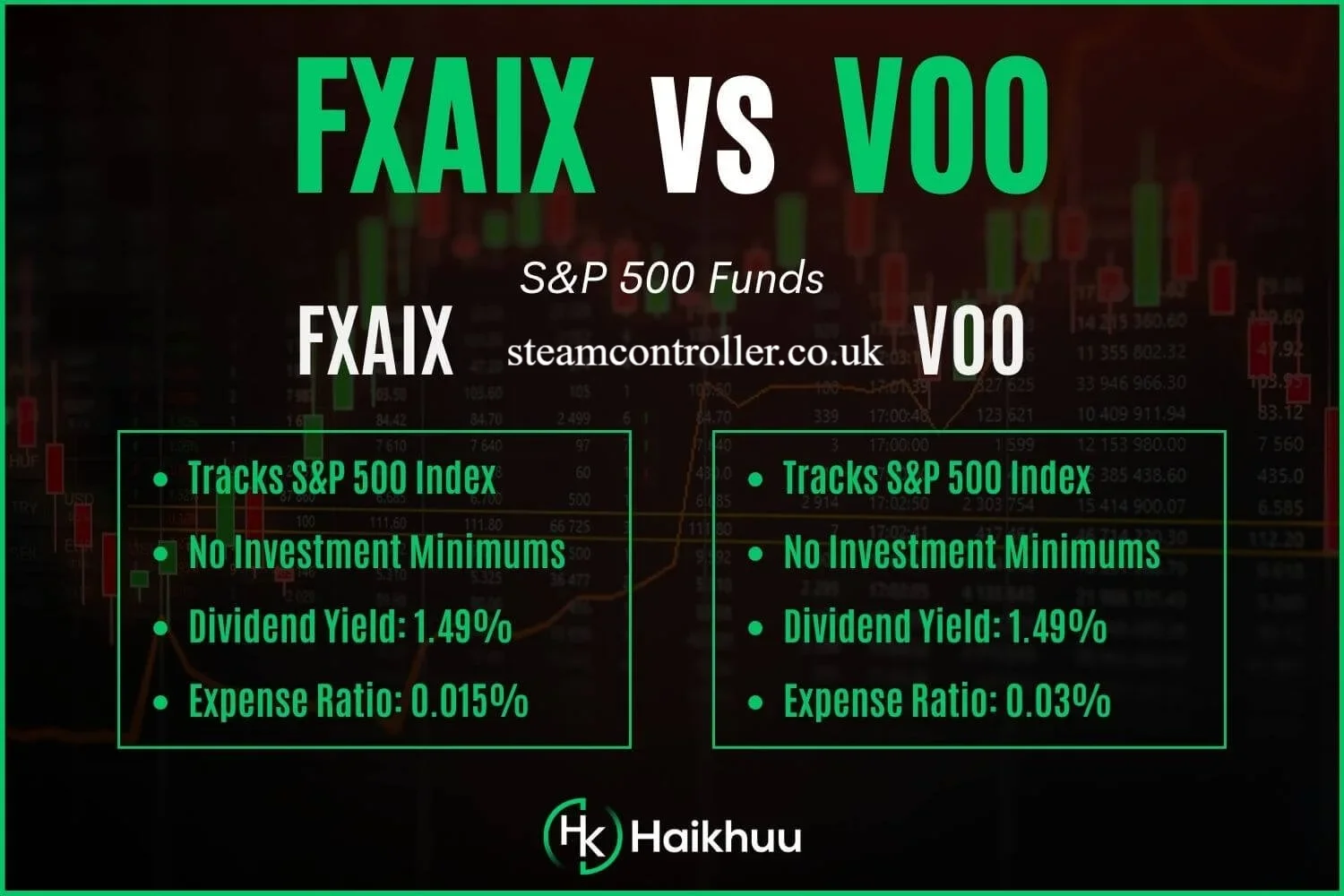
If you had to pick right now, here is the short version. FXAIX and VOO both track the same S&P 500 index, so your returns will look almost identical over time. FXAIX is a mutual fund from Fidelity with a slightly lower expense ratio. VOO is an ETF from Vanguard that trades like a stock and offers more flexibility across brokerages.
Choose FXAIX if you invest through Fidelity and want automatic dollar based investing with zero commission. Choose VOO if you want intraday trading, portability across brokers, or better tax efficiency in a taxable account. Neither choice is wrong. Both are excellent, low cost ways to own the entire S&P 500 in a single fund.
This FXAIX vs VOO comparison breaks down every detail so you can match the fund to your own investing goals, whether that is a 401k, an IRA, or a regular brokerage account.
FXAIX vs VOO: The Core Difference
Before comparing numbers, you need to understand what each fund actually is.
FXAIX stands for the Fidelity 500 Index Fund. It is a mutual fund, which means you buy shares directly from Fidelity at one price set at the end of each trading day.
VOO stands for the Vanguard S&P 500 ETF. It is an exchange traded fund, which means it trades on the stock market all day long, just like Apple or Microsoft shares.
Both funds hold the same roughly 500 large companies that make up the S&P 500 index. Their top holdings, sector weightings, and long term performance track each other closely. The real differences show up in structure, cost, taxes, and how you buy and sell.
FXAIX vs VOO: Structure and Trading Flexibility
This is where the two funds separate the most.
Mutual Fund vs ETF Explained
FXAIX prices once per day, after the market closes at 4 p.m. Eastern time. When you place an order, you do not know your exact purchase price until the trading day ends. This suits investors who buy and hold for decades and never trade during the day.
VOO prices continuously while the market is open. You can buy or sell shares any time between market open and close, place limit orders, and react instantly to price swings. If you like control over your exact entry price, VOO gives you that.
Which Style Fits You?
- Long term, hands off investors: FXAIX works beautifully. You set up automatic contributions and forget about it.
- Active traders or those who value flexibility: VOO is the better tool since it behaves like a regular stock.
- Multi brokerage investors: VOO travels with you to any broker. FXAIX, in most cases, only trades commission free at Fidelity itself.
Which Has Lower Fees: FXAIX or VOO?
Cost is one of the biggest reasons index investing works so well, and both funds are shockingly cheap.
<cite index=”1-1″>FXAIX and VOO have expense ratios of 0.015% and 0.030%</cite> respectively. In plain terms, FXAIX charges about 15 cents a year for every 1,000 dollars invested, while VOO charges about 30 cents. <cite index=”5-1″>Over 30 years on a 100,000 dollar investment growing at 8% annually, that extra cost on VOO adds up to roughly 1,100 dollars.</cite> That sounds like real money, but it is small compared to your total balance after three decades of growth.
So in the FXAIX vs VOO fee battle, FXAIX technically wins. But the gap is so tiny that most investors will not notice it in their daily lives. Where fees can actually bite you is trading costs. <cite index=”5-1″>VOO is commission free at nearly every major U.S. broker, while FXAIX is commission free only at Fidelity, and other brokers may charge 30 to 75 dollars per purchase for non proprietary mutual funds.</cite> That cost difference can easily erase any expense ratio savings if you hold FXAIX outside of Fidelity.
Which Offers Better Long Term Returns?
Here is the honest truth about FXAIX vs VOO performance. Since both funds track the identical index, their returns are nearly a mirror image of each other. <cite index=”4-1″>Both FXAIX and VOO track the S&P 500 with near identical returns historically, so neither holds a structural advantage going forward.</cite>
Any tiny gap you see in historical charts usually comes down to the expense ratio difference and small internal cash management choices each fund manager makes. <cite index=”7-1″>FXAIX has historically outperformed VOO by a tiny margin</cite>, largely because its lower fee lets slightly more of your money stay invested and compound.
I like to think of it this way. If you invest 500 dollars a month in either fund for 25 years, the ending balances will likely differ by less than the cost of a nice dinner. The fund you pick matters far less than staying invested and contributing consistently.
Is FXAIX a Mutual Fund or an ETF?
To be completely clear, FXAIX is a mutual fund, not an ETF. This distinction matters for a few practical reasons.
- You can only buy and sell FXAIX shares once per day, after market close.
- You typically need a Fidelity brokerage account to buy it without extra fees.
- You can often set up automatic recurring investments in exact dollar amounts, including fractional shares, which is harder to do with some ETFs at other brokers.
VOO, on the other hand, is an ETF and behaves like any publicly traded stock, with intraday pricing and broad availability across brokerages.
Tax Efficiency: FXAIX vs VOO in a Taxable Account
If you are investing inside a regular taxable brokerage account, this factor deserves your attention.
<cite index=”6-1″>ETFs like VOO rarely distribute capital gains to shareholders because of their in kind creation and redemption mechanism, meaning tax events are deferred until you personally sell your shares.</cite> Mutual funds like FXAIX work differently. <cite index=”6-1″>FXAIX must sometimes sell underlying securities to meet investor redemptions, which can pass taxable capital gains to all remaining shareholders, even ones who did not sell anything.</cite>
However, <cite index=”6-1″>this tax efficiency gap disappears completely inside tax advantaged accounts like a 401k or IRA, since growth is already sheltered from taxes regardless of fund structure.</cite>
So here is a simple rule of thumb.
- Taxable brokerage account: VOO usually has the edge for tax efficiency.
- 401k, IRA, or other retirement account: The tax difference does not matter, so pick based on cost and convenience instead.
Dividend Distributions Compared
Both FXAIX and VOO pay dividends since the underlying companies in the S&P 500 distribute earnings to shareholders regularly. VOO typically pays dividends quarterly and deposits them directly into your brokerage account, where you can choose to reinvest automatically or take the cash. FXAIX also distributes dividends, usually quarterly, and Fidelity makes automatic reinvestment simple within its own platform.
Dividend yields between the two funds are essentially identical since they hold the same companies in the same proportions.
FXAIX vs VOO: Side by Side Comparison Table
| Feature | FXAIX | VOO |
|---|---|---|
| Fund Type | Mutual fund | ETF |
| Expense Ratio | 0.015% | 0.03% |
| Minimum Investment | None | Price of one share |
| Trading Flexibility | Once daily, after market close | Intraday, real time |
| Best Broker | Fidelity | Any major broker |
| Tax Efficiency | Lower in taxable accounts | Higher in taxable accounts |
| Dividends | Quarterly | Quarterly |
| Long Term Performance | Nearly identical to VOO | Nearly identical to FXAIX |
| Ideal For | Fidelity users, retirement accounts | Multi broker investors, active traders |
Can I Own Both FXAIX and VOO?
Yes, absolutely. Many investors hold both funds without any issue. Since they track the same index, doubling up does not add meaningful diversification, but it is not harmful either. A common example is holding FXAIX inside a Fidelity 401k because it is the plan’s default S&P 500 option, while also holding VOO in a separate brokerage account at another firm for flexibility.
There is no rule against owning both. Just remember that owning both does not reduce risk further since you are essentially holding the same 500 companies twice.
FXAIX vs VOO for Common Investing Goals
Retirement Accounts (401k and IRA)
Inside a 401k or IRA, taxes are not a factor, so the decision comes down to cost and platform. If your Fidelity 401k offers FXAIX as an option, it is an excellent low cost core holding. If your IRA is at Vanguard, Schwab, or another broker, VOO is the easier, more flexible pick.
Long Term Wealth Building
For decades long investing, both funds deliver essentially the same outcome. What actually moves the needle is your contribution amount and consistency, not which of these two funds you choose.
Passive Investing
Both funds fit a true passive, set it and forget it strategy. Automatic contributions work smoothly with either one, especially FXAIX at Fidelity, which supports exact dollar amounts with no minimum investment.
Dollar Cost Averaging
FXAIX often has a slight edge here because Fidelity lets you invest an exact dollar figure, like 250 dollars, without worrying about leftover cash from partial shares. VOO supports fractional shares at most major brokers too, so this gap has narrowed significantly in recent years.
Final Verdict on FXAIX vs VOO
So, which is better, FXAIX or VOO? Honestly, you cannot go wrong with either fund. FXAIX wins on expense ratio and works beautifully for Fidelity based retirement investing. VOO wins on flexibility, broker portability, and tax efficiency in taxable accounts.
My suggestion is simple. Look at where your money already lives. If you are a Fidelity customer, FXAIX is the natural, cost efficient choice. If you invest through Vanguard, Schwab, Fidelity, or any other broker and want a fund that moves with you, VOO is the smarter pick. Either way, you are buying into 500 of the largest companies in America with rock bottom fees, and that is a winning strategy on its own.
What matters most is not FXAIX vs VOO. What matters is starting today, contributing consistently, and letting time do the heavy lifting. Which one fits your account setup better? Take a look at your current broker and make your move.
Frequently Asked Questions
Which is better, FXAIX or VOO? Neither is clearly better. FXAIX has a lower expense ratio and suits Fidelity account holders. VOO offers more trading flexibility and works across any broker. Your choice should depend on where you invest and your trading style.
What are the main differences between FXAIX and VOO? FXAIX is a mutual fund priced once daily, while VOO is an ETF that trades throughout the day. FXAIX has a slightly lower expense ratio, while VOO offers broader broker availability and better tax efficiency in taxable accounts.
Which has lower fees, FXAIX or VOO? FXAIX has a lower expense ratio at 0.015% compared to VOO’s 0.03%. The difference is small but can add up over many decades of investing.
Which offers better long term returns? Both funds track the S&P 500 and produce nearly identical long term returns. Any small gap comes from the slightly lower fee on FXAIX.
Is FXAIX a mutual fund or an ETF? FXAIX is a mutual fund managed by Fidelity. It is not an ETF and does not trade throughout the day like VOO does.
Can I own both FXAIX and VOO at the same time? Yes, you can hold both funds. Since they track the same index, combining them does not add extra diversification but causes no harm either.
Is VOO more tax efficient than FXAIX? Yes, in a taxable brokerage account, VOO is generally more tax efficient because of how ETFs handle share redemptions. This advantage disappears inside retirement accounts like a 401k or IRA.
Does FXAIX have a minimum investment requirement? No, FXAIX has no minimum investment requirement, making it accessible to investors at any starting balance.
Which fund is better for a 401k or IRA? Inside tax advantaged accounts, the tax efficiency gap does not matter, so the decision comes down to which broker holds your account and which fund is available.
Can I buy VOO at Fidelity or FXAIX at Vanguard? You can buy VOO at almost any brokerage, including Fidelity, since it is an ETF. FXAIX is typically only available commission free at Fidelity itself.
steamcontroller.co.uk
Email: johanharwen314@gmail.com
Author Name: Hamid Ali
About the Author: Hamid Ali is a personal finance writer who focuses on index investing, retirement planning, and building simple, low cost strategies for long term wealth. He breaks down complex investing topics into clear, practical guidance that everyday investors can actually use.