Introduction
You have probably heard your team talk about Salesforce Agentforce AI in almost every meeting this year. It is not just hype anymore. Companies are actually putting these AI agents to work, and the results are hard to ignore. Salesforce Agentforce AI now handles real customer questions, updates records, and even closes small tasks without a human clicking a single button. That sounds exciting, but it also raises fair questions about cost, trust, and whether your team is ready.
This article breaks down what Salesforce Agentforce AI actually does, how it works, what the newest numbers say, and where it still struggles. You will also find a simple comparison table, expert opinions, and answers to the questions people search for most. By the end, you will know if Salesforce Agentforce AI fits your business or if you should wait.
What Is Salesforce Agentforce AI?
Salesforce Agentforce AI is a platform built by Salesforce that lets companies create autonomous AI agents inside their CRM. These agents do not just chat. They take action.
An Agentforce agent can look up a customer record, check a return policy, process a refund, or escalate a ticket to a human, all without a person typing a single command. Salesforce calls this shift moving from reactive bots to proactive agents that watch for triggers and act on their own.
In simple terms, think of Salesforce Agentforce AI as a digital employee that lives inside your Salesforce org, reads your data, and completes tasks around the clock.
How Does Salesforce Agentforce AI Work?
Salesforce Agentforce AI runs on a mix of large language models, your company data, and a set of rules called topics and actions. Here is a quick breakdown of the process.
- A trigger happens, such as a customer message, a data update, or a scheduled event.
- The agent reads the relevant CRM data through Salesforce Data Cloud.
- It matches the request to a topic it is trained to handle.
- It performs an action, like updating a field or sending a reply.
- It hands the task to a human only when the situation needs judgment.
This flow is what Salesforce calls Agentforce 2DX, a newer approach where agents act on signals instead of waiting for someone to ask a question first.
Key Features of Salesforce Agentforce AI
Salesforce Agentforce AI packs in several features that set it apart from a basic chatbot.
- Autonomous reasoning that lets agents plan multiple steps on their own
- Native connection to Slack, mobile apps, and embedded web widgets
- Data grounding through Salesforce Data Cloud so answers stay accurate
- Workflow automation powered by MuleSoft and Flow
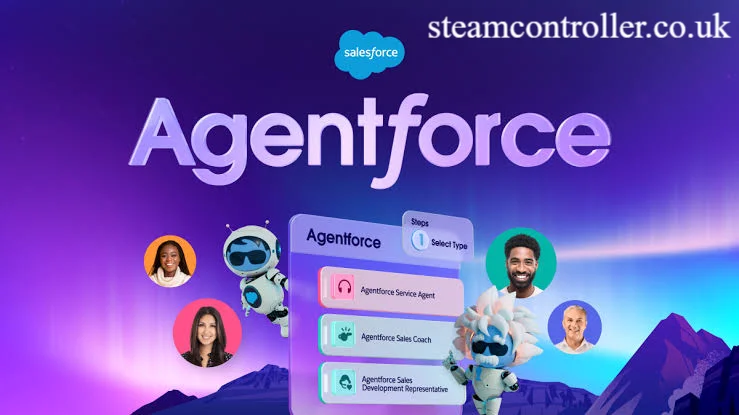
- Prebuilt agents for sales, service, HR, and IT support
- AgentExchange, a marketplace for prebuilt agent components
Salesforce Agentforce AI Feature Comparison
| Feature | Traditional Chatbot | Salesforce Agentforce AI |
|---|---|---|
| Takes real action | Rarely | Yes, across CRM records |
| Learns from company data | Limited | Deep integration with Data Cloud |
| Works inside Slack | No | Yes, natively |
| Acts without a prompt | No | Yes, through proactive triggers |
| Setup time | Weeks | Often under two days |
Salesforce Agentforce AI Statistics You Should Know
Numbers tell the story better than opinions, so here are some fresh figures worth knowing.
- Agentforce and Data 360 reached close to 1.4 billion dollars in annual recurring revenue by Q3 of fiscal 2026, growing 114 percent year over year.
- Salesforce closed roughly 29,000 Agentforce deals within the first 15 months on the market.
- More than 60 percent of Agentforce bookings in Q4 fiscal 2026 came from existing customers expanding their use, not new buyers.
- Businesses that have adopted the platform now run 13 agents on average, and average deployment time dropped 53 percent.
- 94 percent of sales leaders using agents say they are critical to hitting business targets.
- 87 percent of sales organizations now use some form of AI, and adoption is expected to reach nearly nine in ten sellers by 2027.
These figures show that Salesforce Agentforce AI is not a small side project. It is quickly becoming a core part of how sales and service teams operate.
Benefits of Salesforce Agentforce AI
I have spoken with teams who rolled this out, and the wins usually fall into a few clear buckets.
- Faster response times since agents work at any hour without breaks
- Lower support costs because routine tickets no longer need a human
- Better data accuracy since agents update records the moment something changes
- More time for staff to focus on complex or emotional customer issues
- Smoother handoffs between departments through native Slack integration
Challenges of Salesforce Agentforce AI
It would not be fair to only list the good parts. Adoption comes with real friction too.
- Integration complexity, since only about 27 percent of enterprise applications are fully connected
- Concerns about risk and compliance, cited by 42 percent of IT leaders as a top barrier
- A shortage of internal AI expertise, mentioned by 41 percent of teams
- Legacy systems that do not play well with newer agent tools
- The need for strong data governance before agents can be trusted with sensitive tasks
You should weigh these challenges honestly before you scale Salesforce Agentforce AI across your whole organization.
What Experts Say About Salesforce Agentforce AI
Andrew Comstock, who leads MuleSoft at Salesforce, made a point that stuck with me. He said the real success of an agentic enterprise is not about how many agents you deploy. It comes down to how well those agents are discovered and coordinated so they work together instead of creating extra noise.
That view matches what many IT leaders are quietly saying. Deploying agents is the easy part. Managing them well over time is the harder skill companies still need to build.
How to Get Started With Salesforce Agentforce AI
If you are ready to try it, start small and build up.
- Pick one narrow use case, such as answering order status questions.
- Connect clean, reliable data through Data Cloud before adding more agents.
- Set clear rules for when the agent hands off to a human.
- Test with a small group before rolling it out company wide.
- Review performance monthly and adjust the agent topics as needed.
This slow and steady path helps you avoid the integration headaches many companies report.
Conclusion
Salesforce Agentforce AI has moved past the experiment stage. Real companies are using it to answer customers, update records, and free up staff for harder work. The revenue growth and rising adoption numbers back that up. At the same time, integration gaps, compliance worries, and a lack of in house expertise remain real hurdles.
If your data is clean and your team is ready to manage change, Salesforce Agentforce AI can genuinely lighten the load. If your systems are still messy, it may be smarter to fix that foundation first. Either way, this technology is not going away, so now is a good time to explore what Salesforce Agentforce AI could do for your business. What use case would you try first?
FAQs
What is Salesforce Agentforce AI used for? It is used to automate customer service, sales, HR, and IT tasks by letting AI agents take real action inside Salesforce records.
Is Salesforce Agentforce AI free? No, it is a paid add on within the Salesforce platform, and pricing depends on usage and the specific cloud you already own.
How is Salesforce Agentforce AI different from a chatbot? A chatbot mostly answers questions. Salesforce Agentforce AI can also complete tasks, update records, and act without waiting for a prompt.
Can Salesforce Agentforce AI work with Slack? Yes, agents run natively inside Slack, so employees can query CRM data and trigger actions without leaving the app.
Does Salesforce Agentforce AI replace human agents? Not entirely. It handles routine work and hands off complex or emotional cases to human staff.
How long does it take to deploy Salesforce Agentforce AI? Many companies now deploy new agents in under two days, much faster than earlier rollout times.
Is Salesforce Agentforce AI secure for sensitive data? It uses Salesforce Data Cloud for grounding, but companies still need strong governance and access controls before trusting it with sensitive information.
What industries benefit most from Salesforce Agentforce AI? Retail, financial services, and other high volume customer facing industries are seeing the fastest and most measurable results.
steamcontroller.co.uk
Email: johanharwen314@gmail.com
Author Name: Hamid Ali
About the Author: Hamid Ali is a technology writer who covers CRM platforms, artificial intelligence, and business automation. He enjoys breaking down complex enterprise tools into simple, practical guides that help readers make smart decisions for their teams.