

Pokémon Natures are an important part of Pokémon stat optimization. They influence five battle stats: Attack, Defense, Special Attack, Special Defense, and Speed. Most Natures increase one stat while decreasing another, while five Natures are neutral and have no net stat effect. The system was introduced in Generation III and remains a fundamental part of Pokémon training and competitive team building.
If you are trying to choose the best Nature for a physical attacker, special attacker, defensive Pokémon, or Trick Room team, understanding the Nature system makes the decision much easier.
What Are Pokémon Natures?
A Pokémon Nature determines which stat receives a boost and which stat receives a reduction.
There are 25 Pokémon Natures in total. Twenty of them modify two stats, while five are neutral:
- Hardy
- Docile
- Serious
- Bashful
- Quirky
A standard Nature increases one affected stat by 10% and decreases another by 10%. HP is never directly modified by Nature.
For example:
- Adamant: +Attack, −Special Attack
- Jolly: +Speed, −Special Attack
- Modest: +Special Attack, −Attack
- Timid: +Speed, −Attack
- Bold: +Defense, −Attack
This makes Nature selection especially useful when you want to strengthen a Pokémon’s main role while reducing a stat it rarely uses.

Complete Pokémon Nature Chart
Here is the full Pokémon Nature Chart:
| Nature | Increased Stat | Decreased Stat |
|---|---|---|
| Adamant | Attack | Sp. Attack |
| Bashful | Sp. Attack | Sp. Attack |
| Bold | Defense | Attack |
| Brave | Attack | Speed |
| Calm | Sp. Defense | Attack |
| Careful | Sp. Defense | Sp. Attack |
| Docile | Defense | Defense |
| Gentle | Sp. Defense | Defense |
| Hardy | Attack | Attack |
| Hasty | Speed | Defense |
| Impish | Defense | Sp. Attack |
| Jolly | Speed | Sp. Attack |
| Lax | Defense | Sp. Defense |
| Lonely | Attack | Defense |
| Mild | Sp. Attack | Defense |
| Modest | Sp. Attack | Attack |
| Naive | Speed | Sp. Defense |
| Naughty | Attack | Sp. Defense |
| Quiet | Sp. Attack | Speed |
| Quirky | Sp. Defense | Sp. Defense |
| Rash | Sp. Attack | Sp. Defense |
| Relaxed | Defense | Speed |
| Sassy | Sp. Defense | Speed |
| Serious | Speed | Speed |
| Timid | Speed | Attack |
The five same-stat combinations—Hardy, Docile, Serious, Bashful, and Quirky—are considered neutral because the same stat is both increased and decreased.
How Do Nature Effects Change Pokémon Stats?
The simplest way to understand Nature effects is to think of them as modifiers applied to the affected stat.
A positive Nature modifier raises the relevant stat by 10%, while a negative modifier reduces it by 10%. The final result is affected by the Pokémon’s other stat calculations, including its base stats, IVs, EVs, and level.
This is why Nature should not be considered separately from the rest of a Pokémon’s build.
For example, an attacker with strong Attack, appropriate EVs, and good IVs can gain even more value from an Attack-boosting Nature such as Adamant.
Does Nature affect HP?
No. Pokémon Natures do not directly increase or decrease HP.
The Nature system works with:
- Attack
- Defense
- Special Attack
- Special Defense
- Speed
HP is not part of the Nature modifier system.
Which Natures Are Best for Physical Attackers?
For a physical attacker, Adamant and Jolly are two of the most useful choices.
Adamant Nature
Adamant = +Attack, −Special Attack
Adamant is excellent when a Pokémon relies heavily on physical moves and does not need its Special Attack stat.
The advantage is straightforward: you increase damage from physical attacks while reducing a stat that may have little value to the Pokémon’s role.
Jolly Nature
Jolly = +Speed, −Special Attack
Jolly sacrifices some potential power in exchange for greater Speed.
This can be particularly valuable when a Pokémon needs to move before an opponent. In competitive Pokémon, a Speed advantage can sometimes matter more than a modest increase in damage.
Other Attack-boosting Natures
You can also consider:
- Lonely: +Attack, −Defense
- Naughty: +Attack, −Special Defense
- Brave: +Attack, −Speed
Brave is especially interesting for Trick Room Pokémon because lowering Speed can become an advantage under the right conditions.
Which Natures Are Best for Special Attackers?
Special attackers commonly choose Modest or Timid.
Modest Nature
Modest = +Special Attack, −Attack
Modest is a natural choice for a special attacker that does not depend on physical attacks.
It increases Special Attack while reducing Attack, which can be an efficient trade for a Pokémon built around special moves.
Timid Nature
Timid = +Speed, −Attack
Timid prioritizes Speed instead of Special Attack.
It is useful when moving first is more important than maximizing raw Special Attack.
Other Special Attack options
Two additional choices are:
- Mild: +Special Attack, −Defense
- Rash: +Special Attack, −Special Defense
- Quiet: +Special Attack, −Speed
Quiet can be useful on certain Trick Room builds because it lowers Speed while increasing Special Attack.
Which Natures Are Best for Defensive Pokémon?
Defensive Pokémon generally benefit from a Nature that strengthens the defense most relevant to their role.
Bold Nature
Bold = +Defense, −Attack
Bold works well for Pokémon that primarily need physical Defense and do not rely heavily on Attack.
Impish Nature
Impish = +Defense, −Special Attack
Impish is another strong Defense-focused option, particularly for Pokémon that still use physical attacks.
Calm Nature
Calm = +Special Defense, −Attack
Calm strengthens Special Defense while lowering Attack.
Careful Nature
Careful = +Special Defense, −Special Attack
Careful is useful for defensive Pokémon that rely on physical moves but want greater protection against special attacks.
The best choice depends on the Pokémon’s base stats, moveset, EV spread, ability, held item, and intended role.
Why Are Jolly, Adamant, Timid and Modest So Popular?
These four Natures are popular because they match four common competitive goals:
| Nature | Boost | Common Role |
|---|---|---|
| Adamant | Attack | Physical attacker |
| Jolly | Speed | Fast physical attacker |
| Modest | Sp. Attack | Special attacker |
| Timid | Speed | Fast special attacker |
The general strategy is simple: boost the stat your Pokémon needs most and reduce a stat that contributes less to its intended role.
However, there is no universally best Nature. The correct choice depends on the specific Pokémon and team.
How Should You Choose the Best Nature?
Start with the Pokémon’s role, rather than simply choosing the Nature with the biggest-looking stat boost.
Step 1: Check the base stats
Look at whether the Pokémon naturally favors Attack, Special Attack, Defense, Special Defense, or Speed.
Step 2: Check the moves
Physical moves generally make better use of Attack, while special moves use Special Attack.
Step 3: Decide whether Speed matters
If the Pokémon needs to move before specific opponents, a Speed Nature may be more valuable than an offensive Nature.
Step 4: Consider the stat you can afford to lose
For example, a physical attacker may have little use for Special Attack. That makes Adamant or Jolly attractive because both reduce Special Attack.
Step 5: Consider the complete build
Nature is only one part of Pokémon training. IVs, EVs, base stats, moves, abilities, items, and team strategy all contribute to the final result.
What About Trick Room Pokémon?
Trick Room changes the normal Speed strategy.
Under Trick Room, slower Pokémon generally get the opportunity to move before faster Pokémon. As a result, certain slow Pokémon can benefit from deliberately lowering Speed.
Common choices include:
- Brave: +Attack, −Speed
- Quiet: +Special Attack, −Speed
- Relaxed: +Defense, −Speed
- Sassy: +Special Defense, −Speed
For a Trick Room Pokémon, a Speed reduction that would normally seem negative can actually support the team’s strategy.
This is a good example of why there is no single “best” Nature for every Pokémon.
Do Pokémon IVs and EVs Matter With Nature?
Yes. Nature works alongside other elements of the stat system.
IVs are individual values that contribute to a Pokémon’s potential stats, while EVs come from training and can be allocated to specific stats.
A Pokémon with strong IVs and an optimized EV spread can make better use of an appropriate Nature.
Think of the system like this:
Base stats + IVs + EVs + level + Nature modifier = final battle stats
Nature does not replace good training. Instead, it helps fine-tune an already planned build.
Can You Change a Pokémon’s Nature?
In modern Pokémon games, Nature Mints provide a way to change the stat effects associated with a Pokémon’s Nature.
For example, using a Jolly Mint can give a Pokémon the stat behavior associated with Jolly for battle purposes.
However, a Mint does not literally replace the Pokémon’s original Nature identity. The original Nature remains associated with the Pokémon, while the Mint changes the stat modifiers used for its stats.
This distinction matters for mechanics that check the Pokémon’s actual Nature rather than its Mint-modified stat effects.
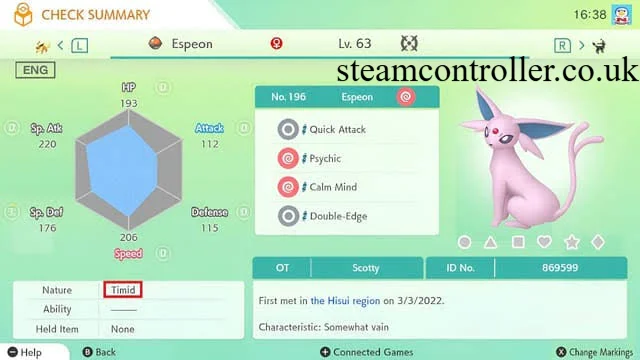
How Do You Check a Pokémon’s Nature?
You can check a Pokémon’s Nature from its summary information in games that display Nature details.
Once you know the Nature, compare it against a Pokémon Nature Chart to determine:
- Which stat is increased
- Which stat is decreased
- Whether the Nature is neutral
- Whether it fits the Pokémon’s intended role
For competitive training, you should then consider the Nature together with IVs, EVs, moves, and the rest of the build.
Do Pokémon Natures Affect Berries?
Yes. Natures are also connected to Pokémon berry preferences.
The five affected stats correspond to berry flavors:
- Attack → Spicy
- Defense → Sour
- Speed → Sweet
- Special Attack → Dry
- Special Defense → Bitter
A Nature determines which flavor a Pokémon likes and which it dislikes. For example, a Sassy Pokémon raises Special Defense and lowers Speed, so it likes Bitter flavors and dislikes Sweet ones.
This is separate from the competitive stat optimization that most players associate with Natures.

Custom FAQ: Pokémon Natures
What is a Relaxed Nature Pokémon?
A Relaxed Nature increases Defense and decreases Speed. It can be useful for defensive Pokémon and certain Trick Room teams where lower Speed is desirable.
Where can I find a Pokémon Natures chart?
A complete chart lists all 25 Natures and shows which stat each one increases and decreases. The chart above provides all 25 Nature combinations in one place.
What is a Sassy Nature Pokémon?
Sassy increases Special Defense and decreases Speed. It can be useful for specially defensive Pokémon and slower Pokémon designed for Trick Room strategies.
What is a Rash Nature Pokémon?
Rash increases Special Attack and decreases Special Defense. It can suit an offensive special attacker when the reduced Special Defense is an acceptable trade-off.
What is a Lax Nature Pokémon?
Lax increases Defense and decreases Special Defense. It can be useful when a Pokémon wants additional physical Defense and can afford to lose some Special Defense.
What is Docile Nature in Pokémon Emerald?
Docile is one of the five neutral Natures. It increases and decreases Defense, resulting in no net Nature modifier to the stat. Pokémon Natures were introduced in Generation III, which includes Pokémon Emerald.
What is a Timid Nature Pokémon?
Timid increases Speed and decreases Attack. It is commonly suited to Pokémon that rely on special attacks and benefit from moving quickly.
What is a Quirky Nature Pokémon?
Quirky is a neutral Nature. It increases and decreases Special Defense, resulting in no net stat modification from the Nature itself.
Final Takeaway
Pokémon Natures are easiest to understand when you stop thinking of them as complicated personality labels and start treating them as small but meaningful stat modifiers.
For a quick starting point:
- Adamant: physical power
- Jolly: physical Speed
- Modest: special power
- Timid: special Speed
- Bold: physical Defense
- Calm: Special Defense
- Brave: physical Trick Room
- Quiet: special Trick Room
- Relaxed: defensive Trick Room
- Sassy: special defensive Trick Room
The best Nature ultimately depends on what the Pokémon is supposed to accomplish. A Nature that looks poor on one Pokémon can be exactly right for another, especially when team strategy, Speed tiers, moves, IVs, EVs, and abilities are considered.
Author Bio: Hamid Ali is a gaming and entertainment writer covering Pokémon, video games, gameplay mechanics, and competitive strategies. He creates clear, engaging, and research-based content to help players make smarter in-game decisions.
Also Read: