
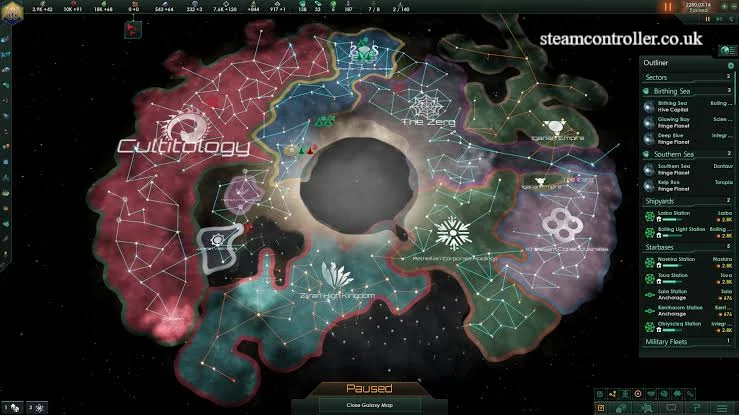
Stellaris is a real-time grand strategy game from Paradox Interactive in which you design an alien civilization, explore a procedurally generated galaxy, and try to build the most powerful interstellar empire. The game never really ends in a predictable way. Your wars, alliances and mistakes shape every session, and that is why people keep coming back to it a decade after launch.
This guide covers what you actually do in the game, how its systems fit together, what changed in 2026, and whether it suits you.
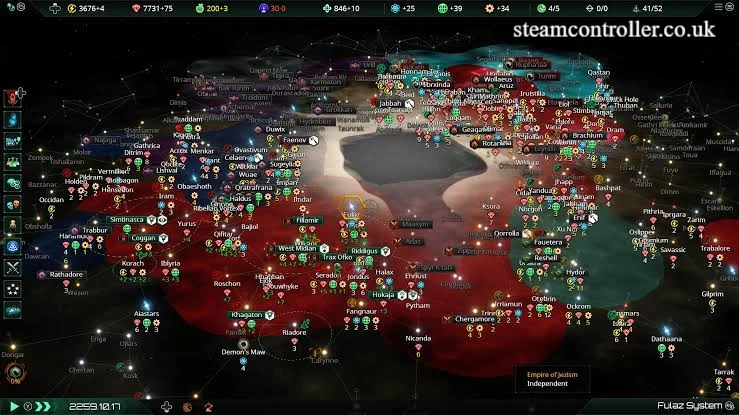
What kind of game is Stellaris?
Short answer: it’s a 4X strategy game (explore, expand, exploit, exterminate) played in real time with a pause button.
Unlike turn-based rivals, time keeps moving while you manage the empire. You can slow the clock or pause to issue orders. That gives the game a steady, simulation-like rhythm: you set a plan in motion, then react as events unfold.
Paradox’s other series (Crusader Kings, Europa Universalis, Hearts of Iron) lean on history. Stellaris swaps history for science fiction, which gives the studio freedom to build odd mechanics like psionic ascension, machine empires and hive minds.
How does a typical Stellaris playthrough work?
Short answer: you create an empire, scout nearby systems, claim territory, grow your economy, and then compete or cooperate with rival civilizations until a late-game crisis tests everyone.
A normal session breaks into four phases:
- Setup. Pick your species, ethics, civics, and origin.
- Early game. Send science ships out, survey systems, and colonize your first planets.
- Mid game. Build up fleets, sign treaties, or start wars.
- Late game. Face galactic events, rival superpowers, and endgame crises.
Creating your own civilization
The setup screen is where much of the replay value comes from. You choose a species portrait and traits, then your empire’s ethics (such as militarist or pacifist), civics, and an origin story that changes how you begin. A peaceful trade federation and a ravenous hive mind will play almost nothing alike, even on the same map.
My practical advice: for a first run, choose a simple, balanced empire and ignore exotic setups until you’re comfortable with the economy.
How does empire management work?
Short answer: you balance resources like energy, minerals, food, and research, while keeping your planets stable and productive.
Expansion is the engine of the game. Each new colony adds output but also adds management work. Stellaris offers tools to ease that burden, including sector-style delegation, where AI governors can run groups of planets so you can focus on the big picture. Automation is handy, but it won’t optimize as well as you do, so check on your core worlds regularly.
Technology advances through research, which you earn from scientists, labs, and special projects. Research choices matter because they unlock stronger ships, better buildings, and new directions for your civilization. Some of the biggest moments in a campaign come from a single lucky tech draw or a risky anomaly investigation.
How do fleets and warfare work in Stellaris?
Short answer: you design ships, group them into fleets under an admiral, and fight in real-time space battles where composition and technology often matter more than raw numbers.
Space combat is less about twitch control and more about preparation. Before a fight you decide ship designs, weapon types, and fleet size. During battle, ships follow stance and range settings, so most of your skill shows up before the shooting begins.
Winning a war involves more than destroying enemy fleets. You also need to:
- Choose a war goal that fits your strength.
- Use ground armies to invade and occupy worlds.
- Protect your own supply lines and chokepoints.
- Know when to accept peace terms instead of overextending.
Fleet management can feel fiddly at first. Keeping a few strong, well-upgraded fleets usually beats scattering weak ones across your borders.
What’s changed recently? Stellaris in 2026
Paradox kept Stellaris busy this year. On June 15, 2026, the studio released the Nomads expansion on PC, centered on a fully upgradable Arkship, trade routes, and a contract system alongside the free 4.4 “Pegasus” update. A notable quality-of-life change in that patch: players can now join and leave wars that are already in progress, which makes diplomacy less rigid.
On the roadmap, the Season 10 pass lists the Willpower expansion for Q4 2026, which reworks ethics into more powerful ideologies.
Earlier in the year, Paradox announced that the Utopia, Synthetic Dawn, and Humanoids Species Pack content would be folded into the base game on May 11, 2026, alongside a $10 base price increase. If you’re buying now, check the current price on your storefront of choice, since pricing and bundles change often.
How does diplomacy work, and can you play peacefully?
Short answer: yes. Pacifist and diplomatic empires can thrive through trade, alliances, and vassals, though you still need defenses.
Diplomatic relations determine who trusts you, who wants your land, and who might join a war against you. You can form alliances, sign defensive pacts, or take on vassals that pay tribute. AI diplomacy is decent but opportunistic: rivals tend to attack when they sense weakness, so a strong military protects a peaceful reputation.
Expect the AI to behave differently depending on its personality and your power. Higher difficulty levels make rival empires more aggressive and efficient, but they remain predictable once you learn their habits.
What are Fallen Empires and endgame crises?
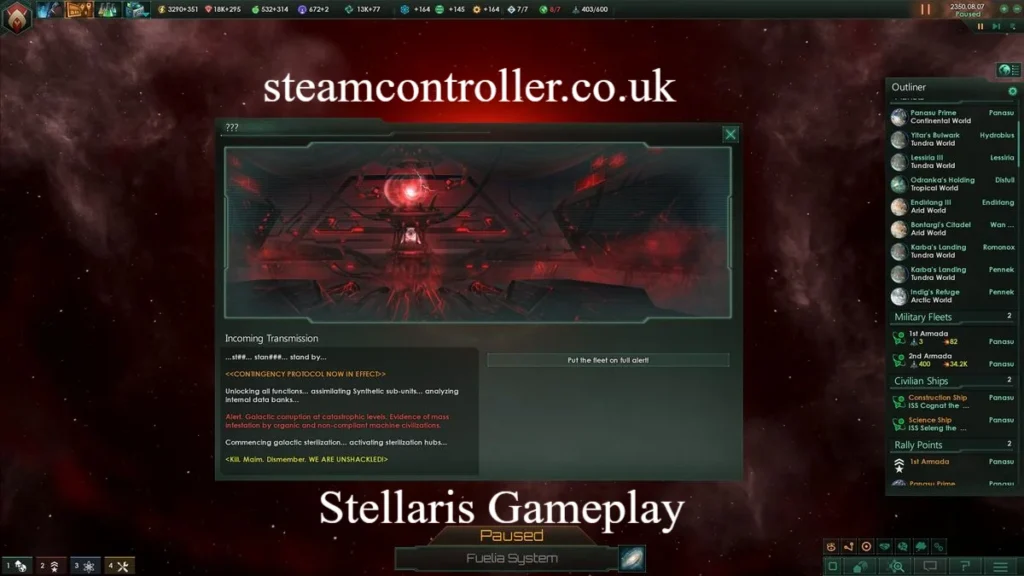
Short answer: Fallen Empires are ancient, powerful civilizations that start strong and can awaken later, while crises are late-game threats that can force every empire to unite or fall.
These two systems give Stellaris its dramatic arc:
- Fallen Empires: relic powers with fleets far stronger than anything you can field early. Leaving them alone is usually wise.
- Crises: large events like the Prethoryn Scourge, the Contingency, and the Unbidden invasion. Each plays differently and can reshape the galaxy.
Crises are why mid-game dominance isn’t the finish line. Even a huge empire can collapse if it’s unprepared.
Is Stellaris good for new players?
Short answer: it is approachable if you’re patient, but it has a real learning curve.
Stellaris has a tutorial and plenty of tooltips, but the systems are deep. Here’s a starting plan I’d suggest:
- Play on a lower difficulty and a smaller galaxy.
- Focus on expanding steadily instead of fighting early.
- Learn one resource system at a time.
- Use automation for secondary planets.
- Save often and read event text before picking options.
Stellaris pros and cons
| Strengths | Weaknesses |
|---|---|
| Huge replay value from origins, ethics, and civics | Steep learning curve |
| Rich diplomacy and war systems | Late-game performance can slow on large maps |
| Frequent updates and expansions | Many DLC add-ons can feel costly |
| Strong modding scene on PC | Some systems feel overwhelming |
How does Stellaris compare with other strategy games?
| Game | Style | Best for |
|---|---|---|
| Stellaris | Real-time grand strategy with pause | Deep empire stories and roleplay |
| Civilization VII | Turn-based 4X | Structured, tactical turns |
| Endless Space 2 | Turn-based space 4X | Faction identity and a cleaner interface |
Stellaris stands out for emergent storytelling. Less polished than turn-based rivals in places, it makes up for it with sheer variety.
Is Stellaris worth playing in 2026?
Short answer: yes, if you enjoy sandbox-style strategy and don’t mind learning complex systems.
It rewards curiosity. If you want tight, scripted campaigns, it may feel loose. If you want to build, break, and rebuild civilizations in new ways, there’s little else like it. Its main caveat is cost: the base game plus expansions can add up, so start with the main game and add content once you know what you enjoy.
Frequently Asked Questions
What does Stellaris gameplay battle look like?
Space battles are real-time fights between fleets. Ships automatically follow stance and range settings, so results depend mostly on ship design, technology, fleet size and your admiral. You can pause and reposition, but you rarely micromanage individual ships.
What’s new in Stellaris gameplay in 2026?
Highlights include the Nomads expansion and free 4.4 “Pegasus” update (June 15, 2026), which lets players join and leave wars already underway. Utopia, Synthetic Dawn, and the Humanoids Species Pack content moved into the base game on May 11, 2026. The Willpower expansion is listed for Q4 2026.
Where can I watch the Stellaris gameplay trailer?
The best place is Paradox Interactive’s official Stellaris YouTube channel, where each expansion trailer is posted. Trailers show cinematic footage and in-game scenes, but they’re promotional, so also watch real player footage for an honest view.
Is Stellaris gameplay available on PS5?
Yes. Stellaris: Console Edition, developed with Tantalus Media, is available on PlayStation 5 and Xbox Series X|S. A full native version for those consoles was announced in November 2025. Console DLC availability can differ from PC, so check the PlayStation Store.
How does Stellaris gameplay on console differ from PC?
The console version uses a controller-friendly interface and may receive content on a different schedule. PC offers mod support and the earliest access to new expansions. For example, Nomads launched first on PC.
Where can I find Stellaris gameplay with no commentary?
Search YouTube for “Stellaris no commentary” along with a specific expansion name. These videos are useful for seeing the interface, pacing, and combat without a narrator, and they’re a good way to preview an origin before you play it.
What does Reddit say about Stellaris gameplay?
The r/Stellaris community is active, with strategy threads, patch discussions, and build guides. Opinions vary: players praise its replay value and storytelling, while common complaints include late-game performance and DLC cost. Treat any single thread as one opinion rather than a verdict.
What is the verdict in a Stellaris gameplay review?
Reviews and player feedback generally describe Stellaris as deep and highly replayable, with a steep learning curve. It’s best for patient strategy fans who enjoy sandbox play and role-playing different empires.
Author Bio: Hamid Ali is a gaming and technology writer covering strategy games, PC gaming, AI, and the latest gaming updates. He creates practical, easy-to-follow guides that help players understand complex game systems and make better gameplay decisions.
Author Name: Hamid Ali
Email: johanharwen314@gmail.com
Also Read: